Background
“On December 3rd, the City of Eugene opened a public comment period regarding the Eugene Clean Fuels Transfer station slated to be developed in the Trainsong neighborhood via a zoning verification (Zoning Verification Decision 24-20).
A zone verification is the process a local government undergoes to confirm, in writing, the allowed use, development standards, and regulations for a specific site. Approval of this zone verification means that the City believes that the site at 799 Bethel Drive is appropriate to host the proposed transloading facility.
This public comment period is in response to the City withdrawing its verification for reconsideration, after community advocacy and legal pressure.” – Beyond Toxics
The Public comment window closed on December 17th. The final decision on the Zoning Verification is pending.
Why should the zone verification be denied?
- The City of Eugene Planning Department issued an approval that is inconsistent with Eugene’s land use code.
- Eugene’s land use code leaves railroad right of ways (such as this site) unzoned, but if a project is proposed, that project must fall within the permitted uses cited in Eugene City Code 9.1070(3).
- City Code 9.1070(3) only allows: tracks, signals, and other operative devices and the movement of rolling stock. The City in the original zoning verification determined that the proposed transloading facility met this definition.
- We think this finding misconstrued the land use code because a fuel transfer facility operated by a private entity that is leasing the land from the Union Pacific Rail Road and that is not itself a rail company, will involve uses inconsistent with permitted uses, and will result in far more infrastructure development and use than originally intended by this City Code.
How is the proposed development inconsistent with City Code?
- The code expressly limits infrastructure on railroad right of ways to be: accommodating tracks, signals, and other operative devices. The operational needs of a transloading facility will surpass these limited uses.
- The code also limits activity on the railroad right of way to “movement of rolling stock,” but the problem is that this is not defined in Eugene’s land use code, nor is there a consistent definition in Oregon’s state regulations.
- The rail industry and federal government typically define “rolling stock” as things on rail wheels that can be moved via tracks.
- The proposed development is inconsistent with this definition because it will involve a series of operational activities that would remove fuel from parked rail cars and transfer the fuel to tanker trucks that are meant for the road, not rail tracks.
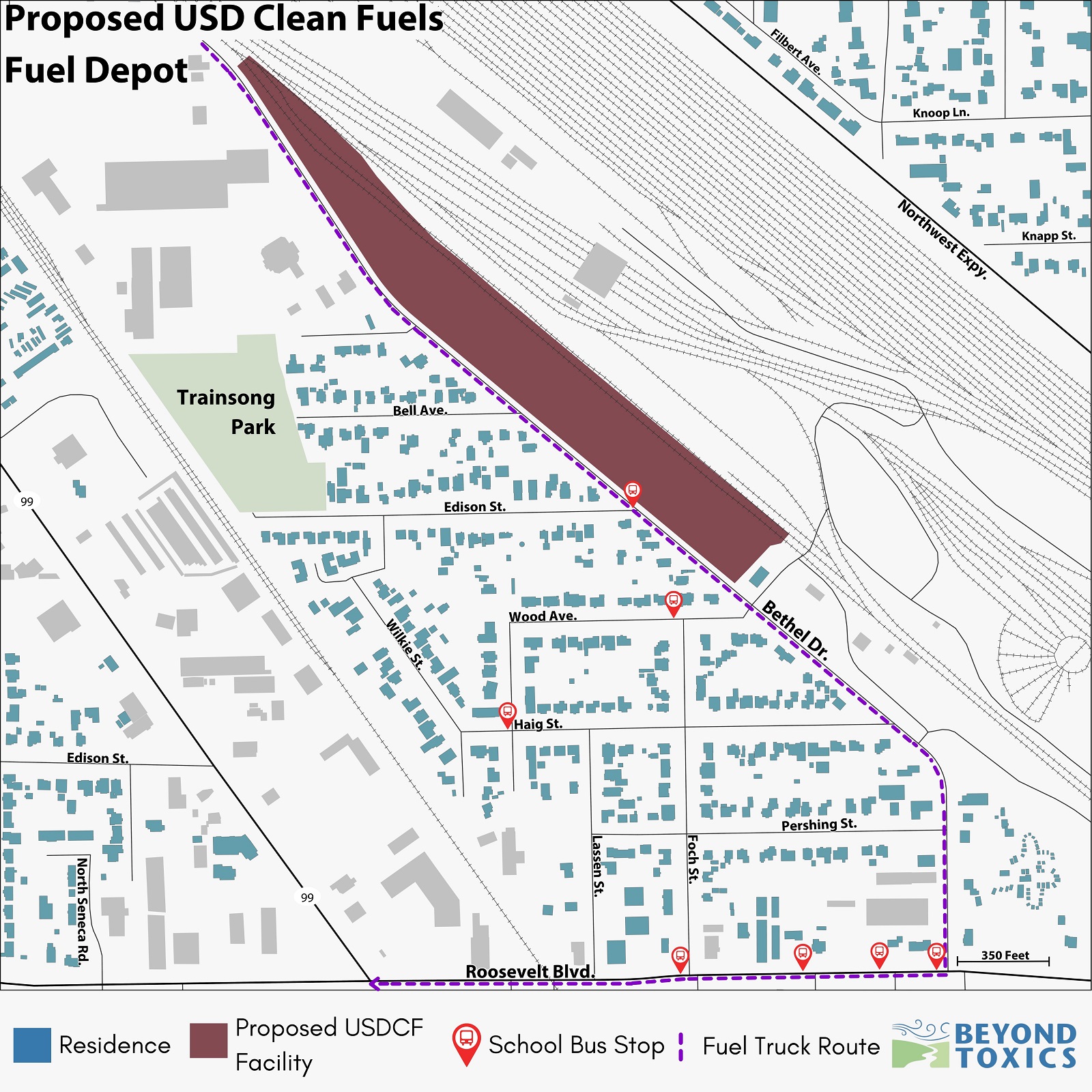
The facility is inconsistent with the Code’s use of the word “movement.” The operations would necessarily require stopping the fuel railcars at the site, and removing them from the main railroad tracks. Then, railcars will be parked on dead-end subtracks for fuels to be loaded in trucks. These rail cars will essentially serve as above ground fuel storage tanks because they will be parked during the fuel transfer process.
Even if “rolling stock” is read broadly to include trucks, the transloading facility would involve permanent built infastructure and operations that exceed the narrow purpose of the right-of-way regulations, which is designed to facilitate the continuous movement of stock.
As a neighborhood, we would like to thank Beyond Toxics for their continued support in this ongoing fight for a better Trainsong. All information shown on this page is quoted, please check out the full article here!
 Trainsong Neighbors